
Your Credit Score.
And More.
Anytime. Anywhere.
Staying on Top of Your Credit Has Never Been Easier.
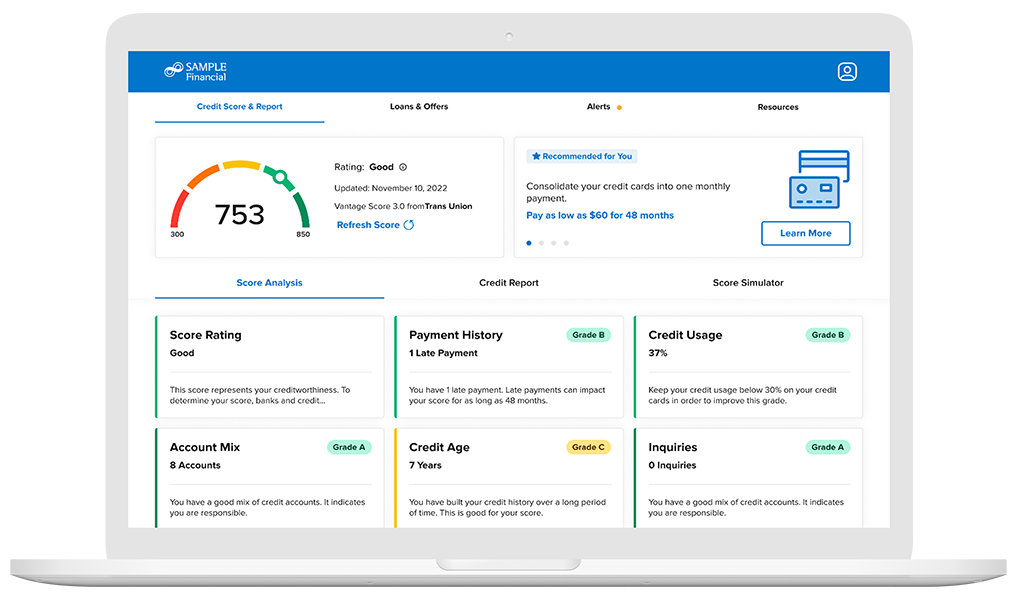
With one powerful tool, access your credit score, full credit report, credit monitoring, financial tips, and education.
All of this without impacting your credit score!
You can do this ANYTIME and ANYWHERE, for FREE, thanks to your Credit Union.
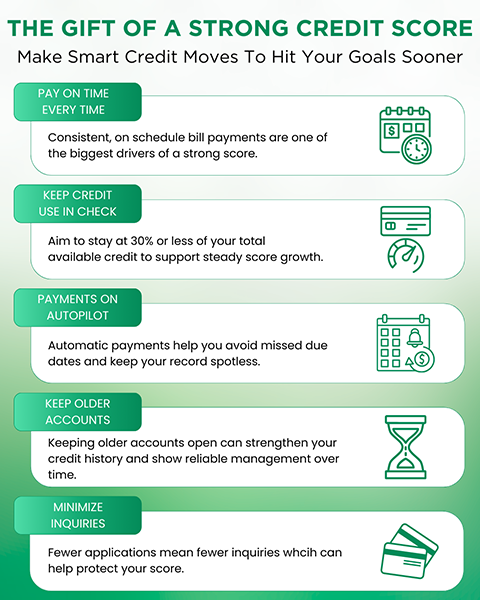
The Benefits of Credit Score & More:
How to Enroll in Credit Score Today:
Option 1: Online Banking
- Log in to online banking.
- Navigate to the Credit Score & Report widget (at the top right column)
- Click on the “Show Full Report” button on the widget to enter.
- If you have not yet, you will need to accept the terms of service to gain access to the service.
Option 2: Mobile App Banking
- Log in to the mobile app on your smartphone or tablet.
- Tap on the “Credit Score & Report” widget (listed at the top of the list of widgets on the Home page).
- You will be taken to the SavvyMoney/Credit Score & Report launch page.
- Tap “Go to SavvyMoney” to enter the widget.
- If you have not yet, you will need to accept the terms of service to gain access to the service.
Frequently Asked Questions:
- Credit Score – General
- What is a Credit Score?
- A credit score is a three-digit number that reflects your creditworthiness, with higher scores indicating more reliability to lenders. It’s calculated based on your credit report, factoring in on-time payments, revolving debt, payment history, and more. Notably, it does not consider age, income, employment, marital status, or bank account balances. For more information, visit the Consumer Financial Protection Bureau website: https://www.consumerfinance.gov/ask-cfpb/what-is-a-creditscore- en-315/
- What is VantageScore®?
- VantageScore® was created by the three major credit reporting agencies: Experian, Equifax, and TransUnion. Developed by a team of statisticians and credit experts, it is used by many financial institutions. The VantageScore® 3.0, which appears in SavvyMoney, is a popular version that ranges from 300 to 850, with 300 being the lowest and 850 the highest score.
- What Does a Good Credit Score Mean to Me?
- A good credit score can lead to easier access to credit and lower interest rates, plus quicker underwriting processes for obtaining credit.
- What Factors Influence My Credit Score? These five categories comprise a credit score:
- 40% Payment History. Lenders want to know if you’re good about paying your loans on time.
- 23% Credit Usage: Credit usage, or credit utilization, is the ratio of your total balance owed to your total credit limit. It’s best to keep it below 30%.
- 21% Credit Age: The age of your oldest and newest accounts, the average account age, and recent account usage all influence your credit history length. Generally, a longer credit history is beneficial.
- 11% Mix of Credit: Your credit score is affected by the number and types of accounts you have. Having a mix of credit, such as mortgages and credit cards, can lead to a higher score.
- 5% Recent Credit: Opening several credit accounts quickly can signal higher risk for lenders. Multiple recent inquiries may suggest you’re struggling to qualify for credit or need quick funds.
- Do Race, Age, and Other, Non-Credit-Related Factors Affect My VantageScore®Credit Score?
- A key misconception about credit scores is what factors the VantageScore® model does NOT consider. It does not take into account race, color, religion, nationality, sex, marital status, age, salary, occupation, employer, employment history, or where you live or shop.
- Credit Report- General
- What is a Credit Report?
- Credit reports, or credit files, contain information about consumers’ credit activities collected by credit reporting companies. They include records of mortgage payments, credit card balances, auto loans, credit inquiries, and accounts in collections, as well as public records. Key details in credit reports include the companies that have extended credit, total loan amounts or credit limits, and payment history.
- Credit reports may include: companies that checked your credit report for loan applications in the last 2 years, your addresses, employers, and other public records.
- Federal law allows one free credit report per year, but credit reporting agencies now offer free weekly reports permanently. You can get a report from Equifax, Experian, and TransUnion weekly at no cost. Visit https://www.annualcreditreport.com or call 1-877-322-8228 to obtain your reports.
- How Can I See What Is In My Credit Report?
- If you’re unsure about your credit report, click on “Credit Report” to check your accounts and payments. Federal law allows one free credit report per year, and the credit bureaus – Equifax, Experian, and TransUnion – are now offering free weekly credit reports permanently.
- How Do I Correct My Credit Report if I Think There Is an Error?
- The three national credit reporting agencies manage billions of pieces of credit data from about 13,000 sources each year, making inaccuracies likely. If you find incorrect information on your credit report, contact the account issuer or the reporting agency. To dispute inaccuracies on your TransUnion report, click “dispute” at the bottom of the SavvyMoney Credit Report. For more details, visit: http://www.consumerfinance.gov/askcfpb/313/what-should-ilook-for-in-my-credit-report-whatare-a-few-of-the-common-credit-report-errors.html
- Why Don’t My Free Credit Reports Include Credit Scores?
- Your credit report and credit score are not the same. Your credit report contains your credit history, which agencies use to calculate your score. Federal law allows you one free credit report annually, but it doesn’t require free credit scores. However, you can now get a free copy of your credit report weekly from Equifax, Experian, and TransUnion.
- What is a Credit Freeze?
- A credit freeze, or security freeze, is a free way to restrict access to your credit report, preventing new accounts from being opened. You can temporarily lift the freeze anytime to apply for credit. It doesn’t affect your credit score, and you can still apply for jobs, rent apartments, purchase insurance, and receive pre-screened offers while it’s in place.
- How to place a credit freeze? Contact each of the three major credit bureaus:
- TransUnion – Phone: (888) 909-8872 / Web: Credit Freeze | Freeze My Credit
- Equifax – Phone: (888) 298-0045 / Web: Security Freeze | Freeze or Unfreeze Your Credit Equifax®
- Experian – Phone: (888) 397-3742 / Web: Security Freeze | Experian
- How to unfreeze your credit profile?
- Contact each of the three major credit bureaus. Each bureau has a different process, but each will provide a PIN for you to begin the unfreeze process.
- Credit Score – Lending
- Do Only Banks and Lenders Use Credit Scores?
- Any institution that lends money—like banks, credit unions, and mortgage lenders—uses credit scores to determine if you meet their lending criteria. They often consider additional information about your employment, income, and down payment plans. Typically, borrowers with higher scores can access more credit at better rates. Additionally, insurance companies may use credit scores to help determine pricing for homeowners and auto insurance policies.
- Is My Credit Score the Only Thing Used by Lenders for Loan Approval?
- Credit score is just one factor lenders consider. Other criteria include the Loan-to-Value Ratio, your income, and your current employment history.
- Building Credit
- How do I Improve my Credit Score?
- Improving your credit report is more important than obsessing over your credit score. Consider these tips:
- Pay your bills on time. Prompt payments have the strongest influence on score.
- Apply for credit only when you need it. Avoid opening multiple accounts within a short time span.
- Keep your outstanding balances low – below 30 percent of the credit limit on each account.
- Reduce your total debt. Consider paying down some of your outstanding loans.
- Build a credit history. Maintain a timely payment history for a mix of accounts (e.g. credit cards, auto, mortgage) over a period of time.
- Improving your credit report is more important than obsessing over your credit score. Consider these tips:
- If I Leave a Balance on a Credit Card Each Month, Will I Build a Credit Score Faster Than Paying The Card in Full Each Month?
- You will not build a solid credit score any faster by carrying a balance than you would if you paid your credit card balance in full each month. The speed at which you build a credit score is largely based on the age of a credit card account, not whether or not you carry a balance. A credit card opened 12 months ago is a one-year-old credit card, regardless of your payoff or balance rollover practices. Additionally, carrying a balance on a credit card each month means you’ll incur interest charges. The best way to build a solid credit score is to manage all of your accounts properly. Best practices include paying all of your credit obligations on time every month, applying for credit only when needed, and keeping balances on credit cards as low as you possibly can if you cannot pay them in full each month.
- Are Charge Cards Treated the Same as Credit Cards by Credit Scoring Models?
- The credit obligation associated with a charge card is similar to, but not the same as, a credit card obligation. As such, there are subtle differences in how they’re considered by credit scores. A charge card is different than a credit card in that the balance is due in full each month, while credit card balances can be carried, or “revolved,” month to month. Charge cards do not have published credit limits, whereas credit cards do. Charge card accounts factor into credit scores, but they are not used by the VantageScore® credit scoring model for calculating various “balance to credit limit” measurements, because of the lack of a credit limit.
- If I Close My Credit Card Accounts, Can I Improve My Score?
- Closing credit cards does nothing to improve your credit scores and, in fact, can backfire and leave you with lower scores. When you close a credit card account, you lose the value of that card’s credit limit in the credit usage calculation. The credit limit is an important component when determining a consumer’s balance to credit limit or the “credit usage” ratio. This ratio rewards consumers who have low credit card balances relative to their credit limits. If you close credit cards, especially those with large credit limits, you will likely cause your credit usage ratio to go up (if you carry balances). This can cause your score to go down, and down considerably in some extreme instances. Additionally, if you close credit card accounts the credit bureaus will eventually remove them from your credit reports. Even though it can take years for an account to be removed from your credit reports, once it is gone you will get no benefit from your responsible management of that account.
- Is Medical Debt a Factor in My Credit Score?
- Medical bills are usually not reported to the credit bureaus unless they have been unpaid for a
- long time and have gone to collections. Collections accounts stay on the report for as long as 7
- years even after you’ve paid them off. These accounts typically have an adverse impact on
- scores, though some scoring models do not include medical collections, especially those with
- small balances of less than $100. VantageScore® 3.0 does not take paid collections accounts
- into account in its model.
- Source: https://www.vantagescore.com/newsletter/your-score-vs-medical-debt/
- Will My Credit Score be Higher the More Loans I Have?
- It’s not the number of loans that generates a good score – it’s how current a borrower keeps
- them and many other factors such as credit utilization, and the age of loan accounts. In other
- words, your score can be impacted positively by taking out only a certain number of sensible
- loans and keeping them in good standing without missing payments.
- Does Shopping for a Loan Hurt My VantageScore® credit score?
- Consumers are encouraged to shop for the best loan rates and conditions. Accordingly, the
- VantageScore® model does not penalize multiple inquiries made within a short period of time.
- When several inquiries are made within a shortened timeframe, it is assumed that the consumer
- is shopping around for a rate and not opening multiple lines of credit.
- The VantageScore® model uses a 14-day rolling window in which all credit inquiries are deduplicated.
- All inquiries within that window are considered one inquiry regardless of the type of
- account. So regardless of whether the credit inquiry is made in response to a mortgage, auto, or
- bank credit card application, it will be counted only once during that 14-day window.
- I’ve Always Heard that the Fewer Credit Cards I Have, the Higher My Score.
- Is This True?
- Credit reports are a reflection of an individual’s credit activity. Accordingly, there are potentially
- countless scenarios where the number of credit cards owned may impact your credit score.
- Prudent handling of your personal finances is the best way to manage debts. Therefore, it is
- generally a good idea to have a limited number of credit cards for long periods of time that have
- low balances and are kept in good standing.
- IN PRODUCT FAQs
- If I Have a Credit Card Balance on my Cards, Will My VantageScore® Credit
- Score Improve?
- If you have a credit balance, it means you don’t owe anything to your credit card lenders and
- they actually owe you, which is good from a personal financial management standpoint. Credit
- balance does not positively or negatively impact a credit score.
- As Soon As I Pay Off My Credit Card Debt, Will My Credit Score Get Better?
- The amount of debt you have in relation to the amount of credit you have available is a
- significant contributor to your credit score; however, it is only one of several factors. While your
- credit card and other loan balances may be low as a result of a recent payment, due to the
- lenders’ reporting cycles, it may take some time for the payments to be reflected in your credit
- score. Moreover, available credit and balances are only one of a number of other factors that
- are considered by credit score models. Improving your credit score can be achieved over time
- by regularly practicing these sound financial management techniques:
- Pay your bills on time
- Apply for credit only when it’s needed; do not open new accounts frequently or open
multiple accounts within a short time span - Keep your outstanding balances low – a good rule of thumb is not to exceed 30% of your
available credit limit with each account - Pay any delinquent accounts as soon as possible and then keep them current
If I Leave a Balance On My Credit Card Will It Help Me Build Credit More
Quickly Than Paying It in Full Each Month?
The balance of an account has no influence over the speed at which you will build or re-build
your credit reports or credit scores. A credit card with a $5,000 balance ages just as quickly as a
credit card with a $0 balance. Further, even if you pay your balance in full each month there’s
no guarantee that the account will show up on your credit reports with a $0 balance. Credit card
issuers report your statement balance to credit reporting agencies. That means even if you pay
your balance in full any subsequent use of the card is going to result in a statement balance
greater than $0.
One of the most effective ways to build or rebuild your credit is by responsibly managing the
accounts that you currently have, or open in the future. Maintaining low balances on credit cards
and never missing a payment will lead to better credit scores. However, that certainly doesn’t
mean you have to live a debt-free life in order to have solid credit. In fact, credit scoring models
reward you for a track record of positive credit experience.
When I Close a Credit Card Account, Will My Credit Scores Always Go
Down?
While it is possible for your credit scores to go down as a result of closing a credit card account,
it’s not definite. The reason your scores could go down would be due to the loss of the credit
IN PRODUCT FAQs
limit of the newly closed card in your debt-to-credit limit ratio measurements. If you are carrying
debt on other credit cards then your debt-to-limit ratio, which is calculated by dividing your
aggregate credit card debt by your aggregate credit limits on open credit cards, will likely go up.
This can cause your credit scores to go down. However, if you are not carrying debt on other
credit cards or the credit limit on the newly closed card was modest enough then the account
closure may not result in a change in your debt-to-limit ratio sufficient to result in a score
reduction.
If I Pay Off Loans or Close Credit Cards, Will it Cause Their Removal from
My Credit Reports?
Credit reporting agencies do not remove accounts once they’ve been closed or paid off. In fact,
there is no law requiring credit reporting agencies to ever remove accounts that are in good
standing. At this time, however, the credit reporting agencies choose to remove inactive or
closed accounts 10 years after they’ve been closed. Additionally, while closed or paid-off
accounts are still on your credit reports they are still considered by credit scoring systems.
If I Don’t Have a Long Credit History, Can I Still Get a VantageScore® credit
score?
One of the differentiating factors of the VantageScore® models is their ability to calculate scores
for more consumers, which includes those that are new to the credit market, are infrequent
users of credit, or have two or fewer credit accounts.
The VantageScore® models are more likely to provide a score for consumers who are very new
to credit and have less than 6 months of history. They also score those who had activity up to
two years ago on at least one of the accounts in their file. Many traditional scores limit this
review to those with at least 6 months of credit history, and who continue to keep their credit
accounts active.
